


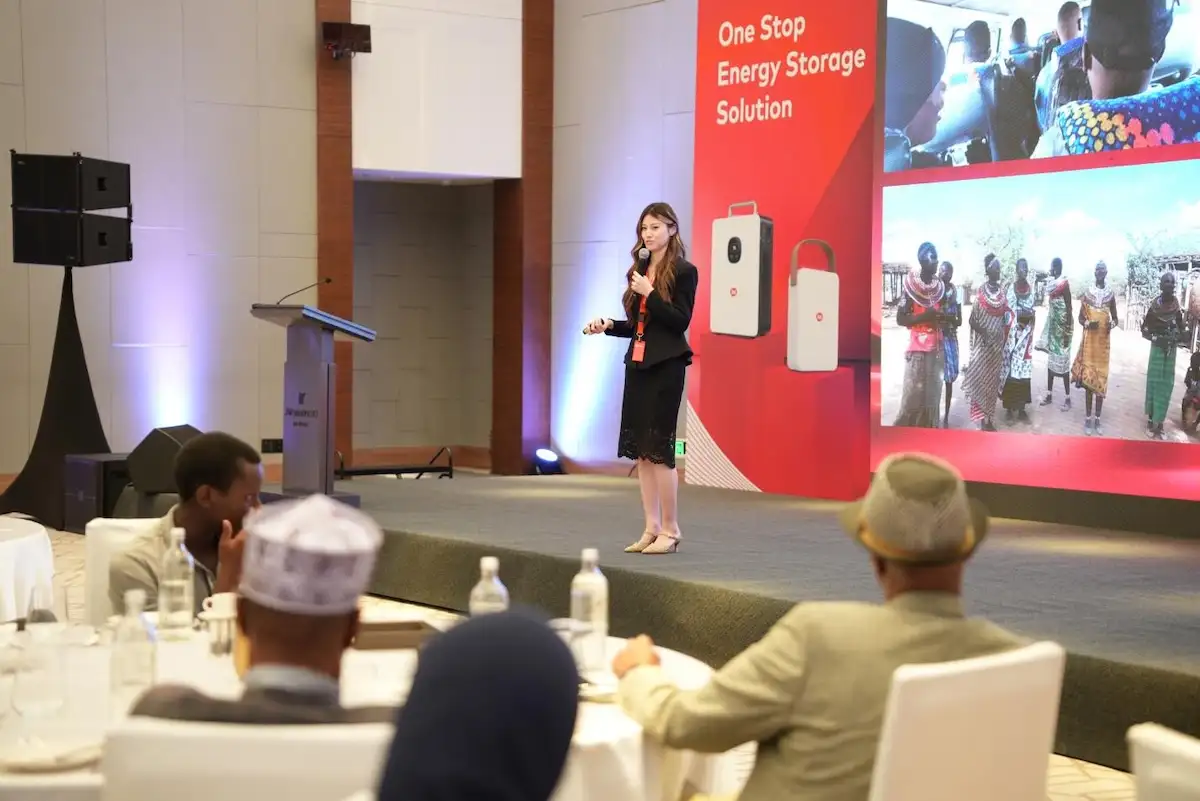
Itel Energy has launched its solar and battery storage business in Kenya, unveiling two portable power stations as it seeks to expand in a market where households and businesses are looking for alternatives to grid electricity during outages.
Wang Zhuoyu, Itel Energy’s Kenya country manager, said the company’s expansion was part of a broader strategy to develop renewable energy and integrated power solutions for emerging markets.
“Our focus is on creating sustainable growth and developing products that address the specific needs of different markets and industries,” she said. “We believe our experience across multiple markets gives us a better understanding of customers and the challenges they face.”
Wang said Itel Energy had taken about two years to become the market leader in Nigeria, an achievement he attributed to its distribution network and product quality.
“It took us approximately two years of sustained effort to become the market leader in Nigeria,” she said. “That achievement is particularly important to us because it reflects two critical aspects of our business: the strength of our distribution network and the quality and sustainability of our products.”
Itel Energy entered the Kenyan market last month and said it had a presence in over 20 countries, eleven of them in Africa. The company said it was also a leading solar energy solutions provider in Pakistan. The launch in Kenya is also intended to open the Somalia and South Sudan markets.
The company distributes hybrid and on-grid inverters, batteries, all-in-one systems, energy storage cabinets and photovoltaic modules. It has seven official service centres in Nairobi, Mombasa, Kiambu, Nakuru, Meru, Uasin Gishu and Kisumu counties, and more than 100 distributors in over 20 towns.
The two portable power stations target different levels of electricity demand. The Power Go is designed for smaller electronic devices, including smartphones, laptops, Wi-Fi routers, LED lights and CCTV cameras.
Its 100,000 mAh battery could keep a household internet router running for several hours or provide backup power for a laptop, depending on the equipment’s consumption and energy losses. Its compact design is aimed at students, remote workers and households needing portable power for essential electronics.
The Power Tank has a 1kWh battery and a nominal AC output of 500 watts, allowing it to operate selected household appliances such as televisions, fans, routers, laptops and LED lighting.
A household could run several of these devices simultaneously, provided their combined electricity demand remains below the system’s output limit. Actual operating time would depend on the appliances connected and their power consumption.
The unit is not designed for high-consumption appliances such as electric kettles, microwaves, irons and cooking equipment, which typically require more than 500W. Refrigerators would also need careful assessment because compressor startup can draw more power than normal operation.
Both products support solar charging. The Power Go accepts solar input of up to 100W, while the Power Tank supports up to 400W, allowing users with compatible panels to recharge the batteries without relying entirely on the electricity grid. The cost and availability of solar panels could, however, increase the initial investment.
Itel Energy’s pricing places the products in a competitive market. EcoFlow’s River 2, which has a 256Wh battery and 300W AC output, has been advertised in Kenya at about Sh26,650, while the River 3, with 245Wh of storage and a 300W output, has been listed at approximately Sh31,370.Bluetti’s Premium 30 V2, with a 320Wh battery and 600W AC output, has been advertised at around Sh34,000.
In the 1kWh category, a comparable YACHU model has been listed at approximately Sh45,000, while EcoFlow’s E980, with 980Wh of storage and a 500W output, has been advertised at around Sh62,380.
Portable battery systems are increasingly marketed as alternatives to petrol generators and fixed inverter installations. Their portability and ability to store solar energy appeal to consumers seeking to keep communications equipment and essential appliances running, although their limited battery capacity and power output mean they cannot replace a full household electricity supply.
One of the Itel Energy partners in Kenya, said the company was working with local partners to develop solar installations in shopping malls and other commercial facilities.
“Together with Itel Energy, we aim to advance solar and battery technology with local market knowledge, professional installation and dependable technical support,” he said.
He said Kenya’s electricity infrastructure could benefit from hybrid energy systems combining solar generation, battery storage and energy management technology, but added that the initial cost remained a barrier for many businesses.
“We recognise that the initial investment remains a challenge for many businesses,” he said. “That is why affordable financing is important. We must work towards making these solutions accessible to more customers.”
Ali said the company’s intention was to complement existing electricity providers rather than compete with Kenya Power, the country’s main electricity distributor.
“Our intention is not to compete with Kenya Power but to work alongside existing electricity providers and complement the national grid,” he said.
Joseph Mwaniki, local service manager, said the company would provide after-sales support to customers using Itel Energy products.
“We will offer all the support the customers may require in after sales,” he said. “In case of any challenges on the Itel Energy products, we request customers to reach out to us through 070969888. They can visit the nearest Calcare office near them because we are present all over Kenya.”
Wang said the company’s longer-term objective was to build a business focused on sustainability and the changing energy needs of customers.
“We want to create opportunities for future generations and build a business founded on respect, sustainability and long-term value,” she said. “Our transition towards renewable energy and integrated energy solutions is part of a broader commitment to supporting Africa and other emerging markets.”
