



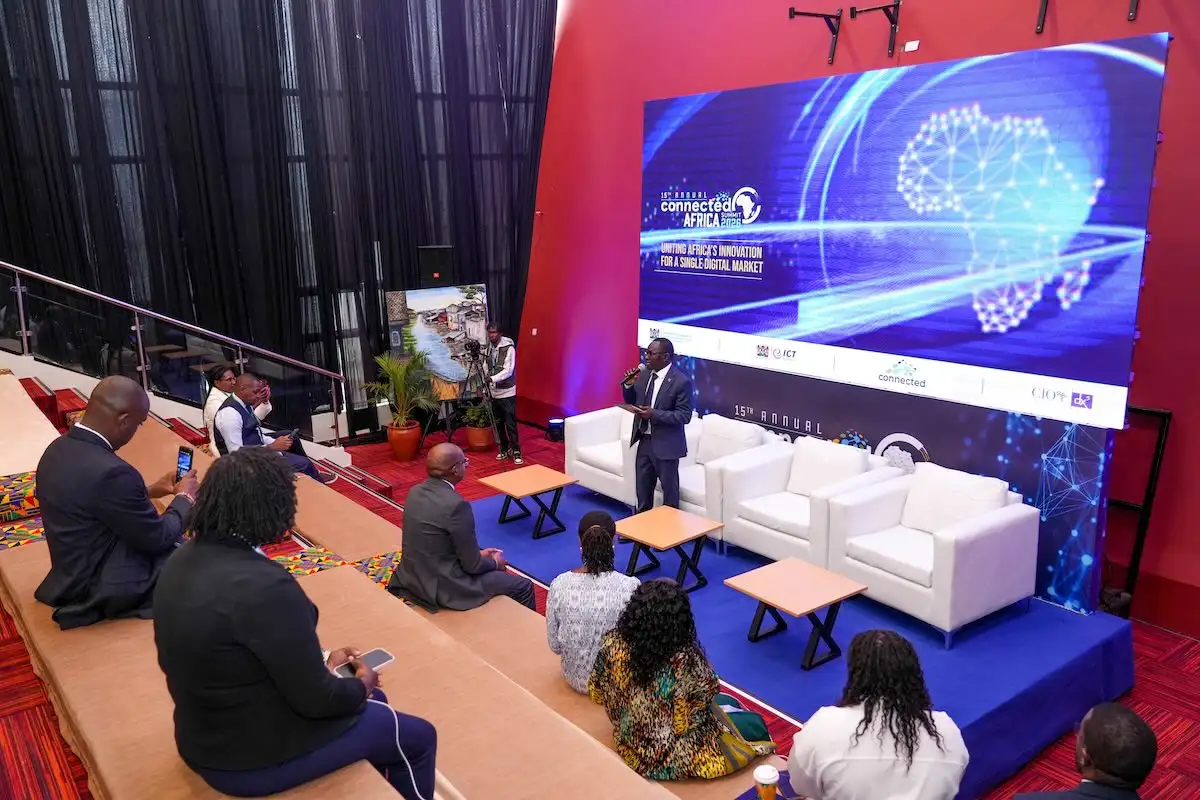
Principal Secretary for Broadcasting and Telecommunications, Mr Stephen Isaboke, delivered a keynote address at the Connected Africa Summit 2026, highlighting Kenya’s strategic response to the evolving challenge of artificial intelligence (AI) weaponisation and its implications for governance, national security and public trust.
Addressing delegates on the theme “The Changing Face of AI Weaponisation in Africa,” the Principal Secretary noted that the rapid growth of digital platforms has created an increasingly complex information environment, where misinformation, disinformation and deepfakes pose significant systemic risks. He cited recent findings indicating that a majority of Kenyan internet users are concerned about the spread of false information, underscoring the urgency of coordinated and context-specific interventions.
PS Isaboke emphasised that Kenya’s response is anchored in deliberate policy direction, including the National Artificial Intelligence Strategy (2025–2030), which provides a comprehensive framework for AI governance, innovation and deployment. He noted that the Government is investing in AI-ready infrastructure, trusted data ecosystems and scalable innovation, supported by a risk-based regulatory approach designed to protect citizens while enabling growth.
He further highlighted ongoing efforts to safeguard the integrity of the digital information ecosystem, including the integration of AI-driven detection tools to identify synthetic and manipulated content, and the strengthening of regulatory mechanisms to ensure accountability across digital platforms. These measures are complemented by a coordinated Government Communication Strategy aimed at enhancing the credibility and accessibility of public information.
The Principal Secretary underscored the importance of digital skills development as a critical pillar of resilience, noting that the Government is scaling training for public communication officers and expanding digital literacy programmes for citizens through initiatives such as Jitume Digital Hubs. He added that learning institutions are increasingly embedding emerging technologies into curricula to position Kenyan youth as creators of globally competitive digital solutions.
Mr Isaboke also reaffirmed Kenya’s commitment to advancing digital sovereignty by promoting the development of locally relevant AI models powered by Kenyan data and reflective of local languages and contexts. He noted that investments under the Digital Superhighway and Creative Economy pillar of the Government’s Bottom-Up Economic Transformation Agenda continue to expand broadband infrastructure, digital access points and connectivity nationwide.
He concluded by calling for a coordinated, multi-sectoral and multinational approach to addressing AI-driven misinformation, emphasising that the future of artificial intelligence lies in responsible enablement. Kenya, he said, is ready not only to adopt AI technologies, but to shape their governance and unlock their value for inclusive national and regional development.
For these and more stories, follow us on X (Formerly Twitter), Facebook, LinkedIn and Telegram. You can also send us tips or reach out at [email protected].
Also Read: Artificial intelligence (AI) could create a turning point for financial inclusion in Africa
