


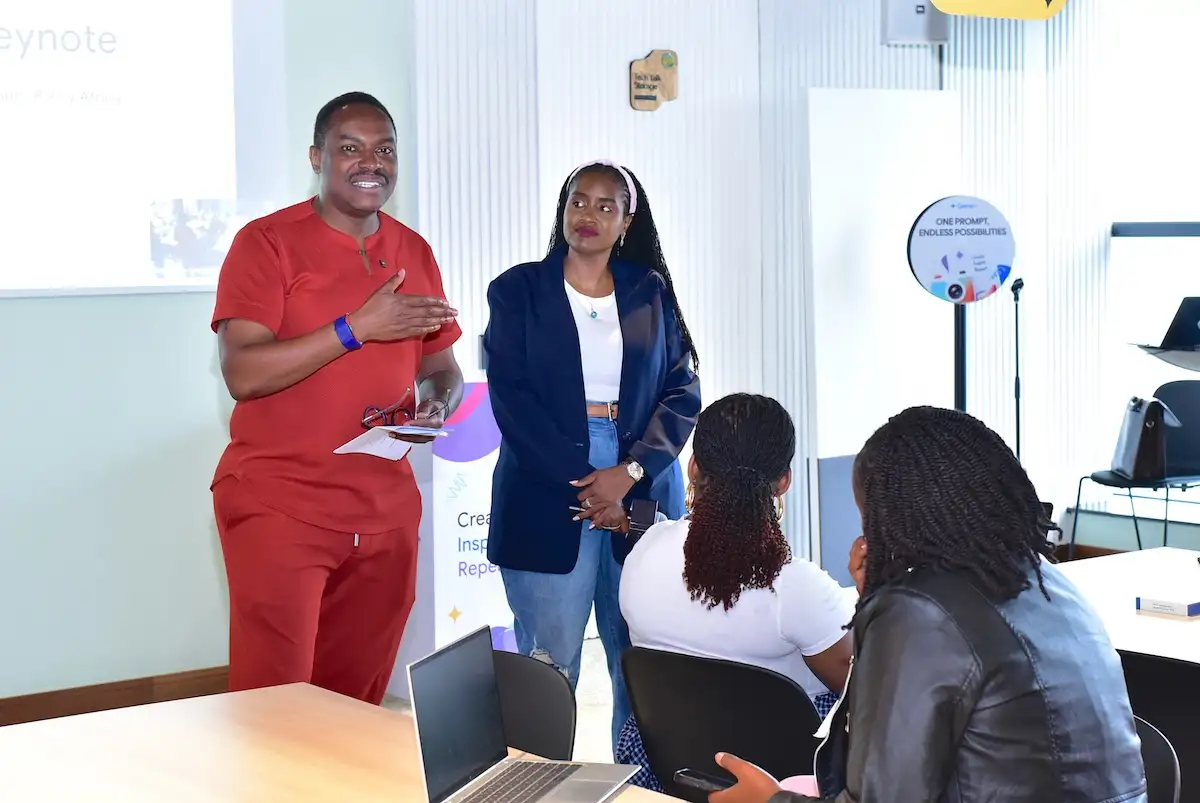
Google’s Regional Director for Government Affairs and Public Policy for Sub-Saharan Africa says Africa has an opportunity to leapfrog legacy technology systems, but skills, infrastructure and access to AI tools will determine how much of that opportunity the continent captures.
I recently had a chat with Charles Murito, Google’s Regional Director for Government Affairs and Public Policy for Sub-Saharan Africa, who said the continent’s relatively limited legacy infrastructure could become an advantage as African developers and businesses increasingly build AI-first solutions in areas such as healthcare, education and agriculture.
“We are uniquely positioned to leapfrog legacy infrastructure,” Murito said. He said that Africa’s demographic growth could help create a strong base for homegrown AI innovation.
Pillars for Africa’s AI growth
Murito said that skills, infrastructure and accessibility are the three areas that need to develop together if Africa is to achieve sustainable AI adoption.
“It’s not just skills,” he said. “We also need to build scalable and resilient infrastructure, which then delivers the connectivity. And then, we must make access to the tools more affordable for more people on the continent.”
Google says it has so far trained more than 6.5 million people since 2017. The company has committed to providing digital skills training to 10 million people in Africa.
The company has also continued investing in the continent’s startup ecosystem through its Google for Startups Accelerator Africa programme. 4 Kenyan startups joined the 10th cohort of the Google for Startups Accelerator Africa program back in April. The four are Comana, Duck, ReportsAI, and VunaPay.
The programme has so far supported more than 190 startups across 17 African countries. Google says the startups it has supported have collectively raised more than $400 million and created more than 3,500 jobs.
Infrastructure remains critical
Murito said Africa needs infrastructure that is scalable, resilient and reliable beyond skills.
That includes extending high-speed connectivity, ensuring alternative routes when subsea cables are disrupted and improving the reliability and latency of networks.
Murito said the continent needs sufficient compute infrastructure to support the development of AI ecosystems and not simply consuming AI products developed elsewhere.
This is crucial as African companies are building AI-powered products of their own.
Google calls for innovation and trust to develop together


Murito said Google believes innovation and trust need to be developed in tandem. We should not treat regulation and innovation as competing objectives.
“Innovation and trust must be built in tandem through pro-innovation frameworks, as well as robust data protection,” he said.
He also called for greater public-private collaboration and transparency when developing AI policies.
Murito said Kenya’s Data Protection Act is an example of a framework that can provide guidance around responsible technology development.
Another area of concern is trust in AI-generated content. Murito said developers need to provide users with tools that can help distinguish between AI-generated content and human-created material. This is important as Gen AI makes it easier to create synthetic text, images, audio and video
Google has been developing tools such as SynthID for identifying AI-generated content.
Kenya’s role in Africa’s AI ecosystem
Murito said Kenya’s combination of technology talent, startups, digital infrastructure and relatively agile policy environment allows it to influence the wider East African technology ecosystem.
“Kenya is really at the epicenter of digital innovation,” Murito said.
AI for African businesses
Murito sees AI as potentially significant for African SMEs and startups because it can give smaller companies access to capabilities that previously required considerably more resources.
“You can go international immediately, and that’s really powerful,” he said.
AI tools can help businesses automate administrative work, analyse information and handle repetitive tasks. This will allow employees to spend more time on higher-value activities.
Local developers can use AI to build solutions specifically around African market inefficiencies. These may range from supply chains to language translation and other highly targeted applications.
For these and more stories, follow us on X (Formerly Twitter), Facebook, LinkedIn and Telegram. You can also send us tips or reach out at info@techarena.co.ke.
Also Read: Google Expands Free AI Plus Access to University Students Across 27 African Countries