


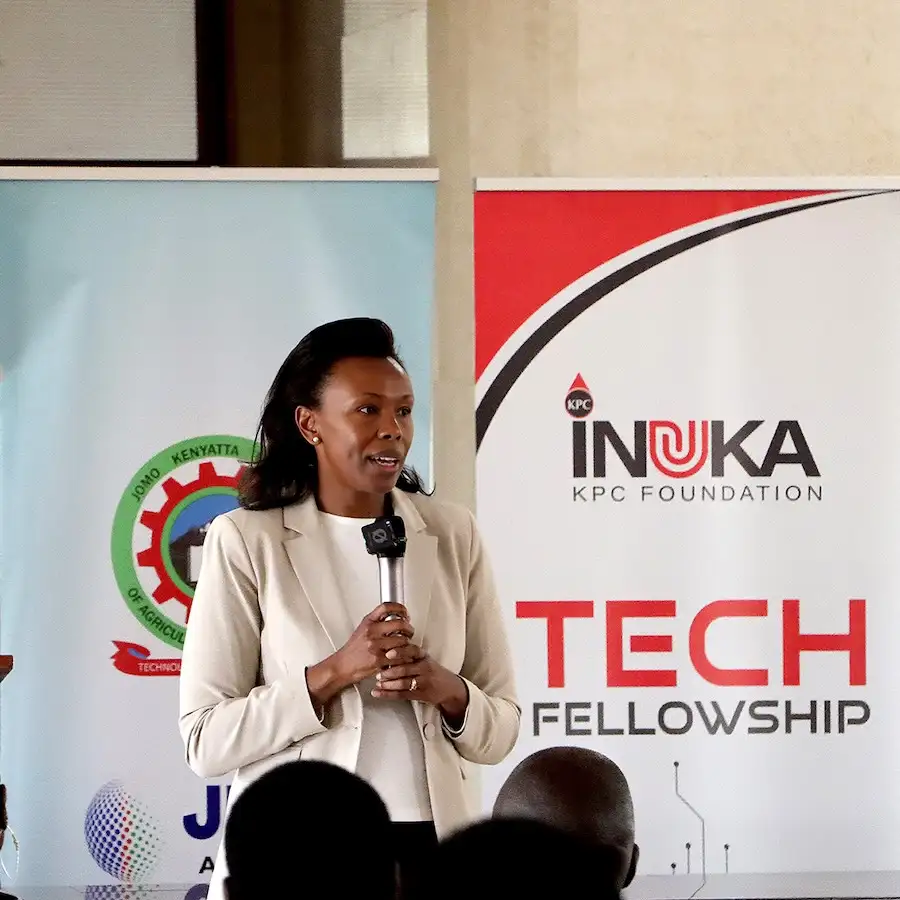
Kenya Pipeline Company PLC (KPC PLC) hosted the inaugural cohort of its Inuka Tech Fellowship at its headquarters on 22nd September 2026, bringing together young technology professionals, programme partners and KPC PLC leadership as the first cohort progresses through a market-led skills development programme designed to improve young Kenyans’ transition into employment. As part of the visit, the young professionals toured KPC PLC’s headquarters to see the company’s day-to-day operations firsthand and met with members of the KPC leadership team.


KPC Foundation is the philanthropic arm of Kenya Pipeline Company PLC. Established in 2016 and registered as a Charitable Trust in 2023, the Foundation has for years driven the Company’s Corporate Social Investment work, with KPC PLC committing at least one per cent of its profits to community programmes.
The Inuka Tech Fellowship is a six-month, in-person programme that follows an apprenticeship-style model, combining technical training with real-world simulations, mentorship and peer learning. Fellows build practical skills in Python, machine learning, dashboard development, automation tools and data storytelling, applying them to real problems across energy, fintech, healthcare, logistics, retail and the public sector.
The Inuka Tech Fellowship, implemented under the KPC Foundation, forms part of the Company’s commitment to youth empowerment and skills development, with a focus on preparing young people for opportunities in Kenya’s rapidly evolving digital economy.
The first cohort attracted more than 1,000 applications, from which 30 fellows were selected. According to Mumbi Ndung’u, Co-founder and Executive Director of Power Learn Project (PLP), a programme partner, the fellows are already moving, into gainful employment, signaling the potential of programmes that connect skills development directly to market needs.
“The programme boasts a 30 per cent absorption rate of trainees into gainful employment,” said Ndung’u.
The fellowship takes a market-led approach to training, with industry needs informing the curriculum and skills developed by the fellows. Rather than training young people based solely on conventional curricula, the programme first seeks to understand what employers need, identify existing skills gaps and then tailor training to address those gaps.
KPC Foundation Manager Rachel Gathoni said this approach responds to a persistent disconnect between employers and young jobseekers.
“Employers are saying, ‘We can’t find the right people,’ while graduates are saying, ‘There are no job opportunities.’ This is where we come in; we assess the gap and try to fill it through these programmes,” said Gathoni.
The model extends beyond classroom-based training, with fellows gaining practical exposure through industry attachments and working on real-world technology challenges. As part of the programme, the 30 fellows from the PLP cohort took part in a hackathon at the iHub centre in Lavington, Nairobi, where they worked in teams to develop practical digital solutions for a real KPC Foundation technology challenge focused on improving how the Foundation manages programmes, beneficiary information, reporting and impact.
The fellowship also places emphasis on diversity and inclusion. Half of the 30 fellows selected for the inaugural cohort are females, an important consideration in technology and engineering fields that have historically had lower female representation.
For the fellows, the programme has provided an opportunity to complement technical training with practical industry exposure and engagement with professionals and KPC leadership. Several fellows have already secured employment following their participation in the programme, reinforcing the fellowship’s focus on making young professionals more prepared for the workplace.
KPC’s leadership also sees development skills as part of building a future-ready workforce and developing the next generation of leaders. Through exposure to industry professionals, practical challenges and workplace environments, programmes such as Inuka create pathways for young people to develop the skills, experience and networks needed to progress in their careers.
“The market informs the curriculum; students are trained, and thereafter they go for attachment and secure jobs,” Gathoni said.
Beyond training, the fellowship gives fellows a structured, job-simulation experience that mirrors real workplace environments, access to an exclusive professional network, and a direct pathway into employment through PLP’s Talent Hub ecosystem. The programme includes theory and practical training, global certification, masterclasses and hackathons. After the six months, fellows are positioned for confirmed roles such as Fibre Optic Technician, Operational Data Analyst, Business Intelligence Analyst, Energy Analytics Specialist, Supply Chain Analyst and Predictive Analytics Engineer, turning the investment into a genuine springboard toward long-term careers in Kenya’s digital economy.
As KPC Foundation works towards expanding the fellowship and reaching more young people, it is also calling for partnerships across sectors including finance, agriculture and technology to strengthen opportunities for skills development and employment.
By linking industry demand to training, practical experience and exposure to the workplace, the Inuka Tech Fellowship is seeking to address both sides of the skills-to-employment equation; helping young people build relevant skills while giving employers access to a more market-ready talent pool.
For these and more stories, follow us on X (Formerly Twitter), Facebook, LinkedIn and Telegram. You can also send us tips or reach out at info@techarena.co.ke.
Also Read: Google Expands Free AI Plus Access to University Students Across 27 African Countries